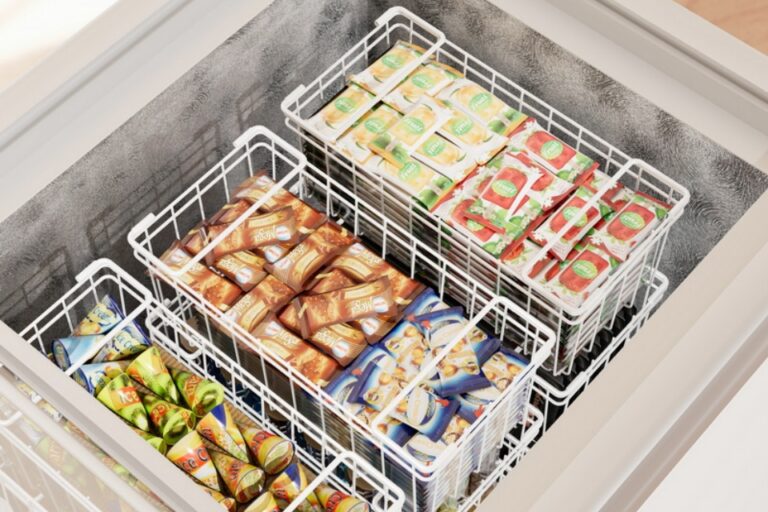
Automazione flessibile e ad alta velocità: Quale si adatta alla vostra strategia?
Questo blog spiega quando l'automazione ad alta velocità o flessibile è adatta al vostro impianto di scaffalature in filo metallico, collegando il mix di prodotti, l'OEE e il changeover a una strategia di linea intelligente.
Picture this: you stand at the end of your wire shelving line, watching parts for freezers and display cabinets come out of the oven. Some days the line runs one SKU all day, like a simple rear mesh. Other days, sales sends you ten different customized orders, all “urgent”.
So the big question comes: do you invest in high-speed automation, or go for flexible automation?
Let’s walk this step by step, with real shop-floor scenes, not only theory. I’ll also use some simple factory “buzz words” like takt time, OEE, changeover, but keep them easy.
Indice dei contenuti
High-speed automation in wire shelving production
High-speed automation means special machines built to do one thing very fast.
In a wire shelving factory, you see it here:
High-speed welding line for one standard shelf size
Automatic cutting and bending cell that only makes one freezer component
A coating line tuned for one fixed hanging pattern and one color
When demand is stable, this type of automatoin is beautiful.
Cycle time is short.
Takt time is easy to match.
But there is a trade-off:
Once you lock in the design, the line does not like change. New size? New layout? You start talking about new jigs, re-engineering, long downtime. Your capacity stands still while orders wait.
Flexible automation for mixed-SKU orders
Flexible automation is different.
You still use robots, conveyors, fixtures, but they are programmable and adjustable. You can:
Change programs on a welding robot
Swap fixtures for different shelf sizes
Re-teach pick points for new commercial display hooks
Adjust recipes in the coating oven for different parts
This fits really well when you handle many SKUs, smaller batches, and lots of “special requests”
You can even plug automation into your componenti per vetrine commerciali line step by step: start with a flexible welding robot, then add smart jigs, then integrate with your powder coating rack system.
Production mix and automation strategy
Let’s make this more clear with a simple view.
Production mix comparison table
| Factor                        | High-speed automation                         | Flexible automation                             |
|-------------------------------|-----------------------------------------------|-----------------------------------------------|
| Typical product mix           | Few SKUs, large batches                       | Many SKUs, small / medium batches             |
| Changeover frequency          | Rare                                          | Very frequent                                  |
| Changeover time               | Long, hardware-heavy                          | Shorter, more software / fixture based        |
| Best for                      | Stable, repeat orders                         | Project work, OEM/ODM, seasonal products      |
| Main risk                     | Product change makes line outdated            | More complex to program and maintain          |
| Main benefit                  | Lowest cost per part at high volume           | High flexibility, better response to market   |
You can already see the basic rule:
80% volume from 1–2 SKUs? High-speed automation is your friend.
Orders jump between many designs? Flexible automation fits better.
Cycle time, takt time and real OEE
On paper, high-speed lines always “win”. Cycle time is tiny. But your finance team does not live on paper, they live on real OEE.
A few key ideas:
Cycle time – how fast one part is made in pure machine time.
Takt time – how fast you need to finish one part to match customer demand.
OEE – how much of the planned time the line runs with good output.
With high-speed automation:
Cycle time is super low.
But when you change model or fix a small issue, the full line can stop.
So your OEE drops when you have many changeovers or unstable demand.
With flexible automation:
Cycle time is sometimes a little slower.
But you change SKU with programs and jigs faster.
So your effective throughput per week may be higher in real life.
In simple words:
On a mixed-SKU line, the “slower” flexible cell can beat the “faster” fixed line, because it almost never waits.
Labor skills, maintenance and shop-floor reality
Automation is not only hardware. It’s people.
Labor and skill requirements
High-speed automation
Operators often do loading, checking, packing.
Maintenance is more about mechanical parts, lubrication, simple sensors.
If something big breaks, you call the OEM engineer.
Flexible automation
You need technicians who can teach robots, tune programs, read logs.
Your team must understand I/O, basic PLC, maybe simple vision system.
Training is longer, but then the same team can support many product types.
This is where a partner like QIAO makes sense. A supplier who already designs custom wire shelving manufacturing services, knows freezer components, rete posteriore, scaffalature per celle frigorifere, can help you:
Choose where to use high-speed machines (for stable, big runners).
Design flexible cells for OEM/ODM projects.
Plan training so your team doesn’t feel scared by the new equipment.
Yes, flexible automatoin can look scary at first. But once your engineers run it for a few months, you dont want to go back.
Automation ROI and risk (without hard numbers)
You asked for no exact cost numbers, that’s fine. Let’s keep it simple.
High-speed automation ROI logic
High-speed automation usually:
Needs higher upfront investment for tooling and custom machines.
Gives you lower cost per piece when volume is very high and stable.
Becomes risky if product life is short, or design changes often.
If your best-seller freezer shelf will stay almost the same for many years, and your customer gives long contracts, the risk is smaller.
Flexible automation ROI logic
Flexible automation usually:
Costs a bit more per part in direct machine time.
But keeps running when prices, designs, or SKUs change.
Lets you enter new OEM/ODM projects fast, without new full lines.
In a world where buyers want more custom sizes, special coatings, new types of componenti per vetrine commerciali, this risk reduction is real money, even if we don’t write the numbers here.
Choosing automation for commercial display cabinet components
Now, bring everything back to your actual business.
When you do this mix, your factory is not “locked” into one future. You can still run fast on big runners, and at the same time say “yes” when a new customer sends a strange CAD file for a display cabinet shelf.
A short checklist before you decide
You can use these questions in your next meeting:
Do 1–2 SKUs bring most of our volume?
How often do we change designs for shelves or cabinet parts?
Can we keep a strong team who knows robots, PLCs and simple software?
How long do we expect each product family to stay in the market?
Do we want to grow more in customized ODM / OEM orders, or mainly in standard catalog items?
If you answer “yes” to many SKUs, frequent changes, more OEM/ODM, flexible automation should be a core part of your strategy.
If you answer “yes” to few SKUs, huge volume, long stable contracts, high-speed automation can still be your main powerhouse.
In the end, you dont need to pick only one side. The smart way is a hybrid line-up: fast lines for your stars, flexible cells for the rest — and a partner like QIAO to help you design it so your wire shelving business stays sharp for many years.
Produttore di scaffali metallici personalizzati con un basso MOQ (50 set). Ordini flessibili da parte di OEM e distributori, scaffalature di resistenza industriale personalizzate in base alle vostre specifiche.
Ciclo di consegna e supporto
Produzione rapida e spedizione globale. Assistenza 24 ore su 24, 7 giorni su 7, logistica affidabile per componenti di refrigerazione, congelatori e scaffalature in filo per bevande in tutto il mondo.
Qualità e certificazioni
Fornitore di scaffalature certificato ISO 9001, NSF e CE. Il rigoroso controllo di qualità garantisce scaffalature industriali in filo metallico e scaffali per bevande di lunga durata in tutto il mondo.